




Effective Mutual Agreement Procedures
Tax AlertOECD effective mutual agreement manual procedures
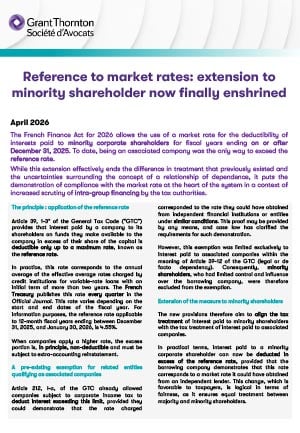
The French Finance Act for 2026 allows the use of a market rate for the deductibility of interests paid to minority corporate shareholders for fiscal years ending on or after December 31, 2025. To date, being an associated company was the only way to exceed the reference rate.
While this extension effectively ends the difference in treatment that previously existed and the uncertainties surrounding the concept of a relationship of dependence, it puts the demonstration of compliance with the market rate at the heart of the system in a context of increased scrutiny of intra-group financing by the tax authorities.
Article 39, 1-3° of the General Tax Code (“GTC”) provides that interest paid by a company to its shareholders on funds they make available to the company in excess of their share of the capital is deductible only up to a maximum rate, known as the reference rate.
In practice, this rate corresponds to the annual average of the effective average rates charged by credit institutions for variable-rate loans with an initial term of more than two years. The French Treasury publishes this rate every quarter in the Official Journal. This rate varies depending on the start and end dates of the fiscal year. For information purposes, the reference rate applicable to 12-month fiscal years ending between December 31, 2025, and January 30, 2026, is 4.55%.
When companies apply a higher rate, the excess portion is, in principle, non-deductible and must be subject to extra-accounting reinstatement.
Article 212, I-a, of the GTC already allowed companies subject to corporate income tax to deduct interest exceeding this limit, provided they could demonstrate that the rate charged corresponded to the rate they could have obtained from independent financial institutions or entities under similar conditions. This proof may be provided by any means, and case law has clarified the requirements for such demonstration.
However, this exemption was limited exclusively to interest paid to associated companies within the meaning of Article 39-12 of the GTC (legal or de facto dependency). Consequently, minority shareholders, who had limited control and influence over the borrowing company, were therefore excluded from the exemption.
The new provisions therefore aim to align the tax treatment of interest paid to minority shareholders with the tax treatment of interest paid to associated companies.
In practical terms, interest paid to a minority corporate shareholder can now be deducted in excess of the reference rate, provided that the borrowing company demonstrates that this rate corresponds to a market rate it could have obtained from an independent lender. This change, which is favorable to taxpayers, is logical in terms of fairness, as it ensures equal treatment between majority and minority shareholders.
The assessment of whether comparables are analogous is made in light of the specific circumstances of the borrowing company and the characteristics of the transaction under consideration. While case law has relaxed the requirements for demonstrating the market rate by accepting the use of yield curves or algorithmic rating software, judges remain extremely strict, particularly regarding the validity or reliability of the comparability adjustments made.
This exercise is technical in nature and subject to a constantly evolving framework (see, most recently, CAA Paris, 2nd Chamber, Jan. 15, 2026, 24PA02156, SAS Le Trema Holding France).
This reform creates new opportunities for taxpayers financed by minority shareholders that qualify as corporate entities.
This is a genuine opportunity, but it must be handled with care, as intra-group financial transactions are a key focus of scrutiny for tax authorities, as evidenced by the proliferation of court decisions on this subject.
In this context, demonstrating the arm’s-length rate requires a robust economic and tax justification. This justification must be consistent with the latest developments in case law to withstand scrutiny by tax authorities and judges.
Grant Thornton Société d’Avocats’ transfer pricing team is at your disposal to provide recognized expertise to secure your intra-group financing and define a market rate in accordance with best practices.






The management of intangible assets is challenged by transfer pricing controls: a question of legal ownership and economic ownership

The annual transfer pricing return (form 2257-SD) must be submitted electronically within six months following the corporate income tax return filing deadline.