
• Skip to content
  • Skip to navigation
  • English
  • français
  • English
  • français
Global site
Grant Thornton Société d'Avocats
  • Insights
    • Fiscalité Générale des entreprises
      • Fiscalité Générale des entreprises
      • Pilotage de la politique fiscale
      • Gestion de la croissance
      • Contrôle et contentieux fiscal
    • Fiscalité transactionnelle
    • Prix de Transfert
      • Prix de Transfert
      • Structuration stratégique et sécurisée des prix de transfert
      • Activités à l’international et Business restructuring
      • Contrôles fiscaux en matière de prix de transfert
      • Obligations déclaratives accrues et généralisées
    • TVA
      • TVA
      • TVA domestique et internationale applicable à vos flux
      • TVA bancaire et financière, TVA dans le secteur assurance
      • TVA immobilière et droits d’enregistrement (DE)
      • TVA dans le secteur public et associatif
      • TVA, contentieux fiscal et relations avec l’Administration
      • Règles applicables en matière de facturation
      • Problématiques douanières liées à vos flux internationaux
      • Obligations déclaratives et d’immatriculation à la TVA
      • Taxe sur les salaires
      • Autres taxes indirectes
    • Fiscalité Patrimoniale
      • Fiscalité Patrimoniale
      • Le Diag Transmission
    • Droit économique
      • Droit économique
      • Stratégie de distribution
      • Digitalisation des activités de distribution
      • Relations entre fournisseurs et distributeurs
      • Politique contractuelle des entreprises
      • Contrôle et contentieux en matière de délais de paiement
      • Relations commerciales avec les consommateurs
      • Droit des données personnelles - RGPD
      • Baux commerciaux
    • Droit social et Ingénierie RH
      • Droit social et Ingénierie RH
      • Prestations traditionnelles
      • Santé au travail et qualité de vie au travail
      • Audit du Management des Ressources Humaines
      • Ingénierie RH & People Change
      • Gestion de la conformité RH et des enquêtes internes
    • Droit des sociétés
      • Droit des sociétés
      • Conseil dans la structuration juridique
      • Gestion courante des entreprises
      • Réorganisation d’entreprises
      • Cession et acquisition d’entreprises
      • Evolution de l’actionnariat – Emission de valeurs mobilières
      • Gouvernance et maîtrise des risques juridiques
    • Mobilité Internationale
      • Mobilité Internationale
      • Développement d’une politique de mobilité internationale
      • Mobilité - Obligations déclaratives des salariés
      • Conseil en matière de sécurité sociale
      • Assistance en matière de droit du travail
    • Propriété intellectuelle et technologies de l’information
      • Propriété intellectuelle et technologies de l’information
      • La gestion et l’exploitation de vos portefeuilles de droits
      • La sécurisation de vos projets : conseil et rédaction contractuelle
      • La défense de vos droits : précontentieux et contentieux
  • Nos experts
  • People & Culture
    • L’expérience de la confiance
    • Pourquoi nous choisir
    • Nous rejoindre
    • Un parcours de formation sur-mesure
  • Nos engagements RSE
  • Nos bureaux
  • Actualités
Global site
  1. ACCUEIL
  2. Press releases
  3. 2015
  4. US$250bn in overseas real estate investment driven by gut feeling rather than data

US$250bn in overseas real estate investment driven by gut feeling rather than data

09 sept. 2015

US$250bn in overseas real estate investment driven by gut feeling rather than data

Grant Thornton warns reliance on instinct can lead investors to miss emerging pockets of opportunity for growth

Soft power and gut instinct is driving an estimated US$250bn per year* in overseas real estate investment, a new report by Grant Thornton reveals, showing that feeling rather than data analysis determines many investment decisions. This comes amid a surge of overseas real estate activity as investors seek new bedrocks of political stability. However Grant Thornton warns that reliance on instinct, while important, can lead investors to miss emerging pockets of opportunity if not complemented by more analysis and using local expertise.

Cross-border real estate transactions rose by 9% in the first half of 2015** and according to research conducted by Grant Thornton for its new report Uncovering opportunities for overseas investment and growth, this surge is being driven by a growing desire to seek politically stable regions for investment. When it comes to making location decisions, gut instinct is the dominant driver. When asked what drives their decision to enter and make a significant investment in a foreign market, over half of senior executives in Canada (51%), Australia (51%), USA (58%), UK (58%) and India (61%) said that ‘it simply feels like a good fit’.

Sian Sinclair, Global leader – real estate and construction at Grant Thornton, said:

“The cross-border real estate investment market is in a purple patch, as a whirlwind of demographic and political changes reshape the global landscape and force savvy, progressive investors to seek stability in new territories.

“Against this backdrop, what really stands out from our study is that the sheer force of familiarity cannot be underestimated. Put simply, investors like putting their money into territories they know. It’s a double-edged sword though. Without more comprehensive analysis alongside it, gut instinct can blind investors to emerging opportunities in less familiar locations.”
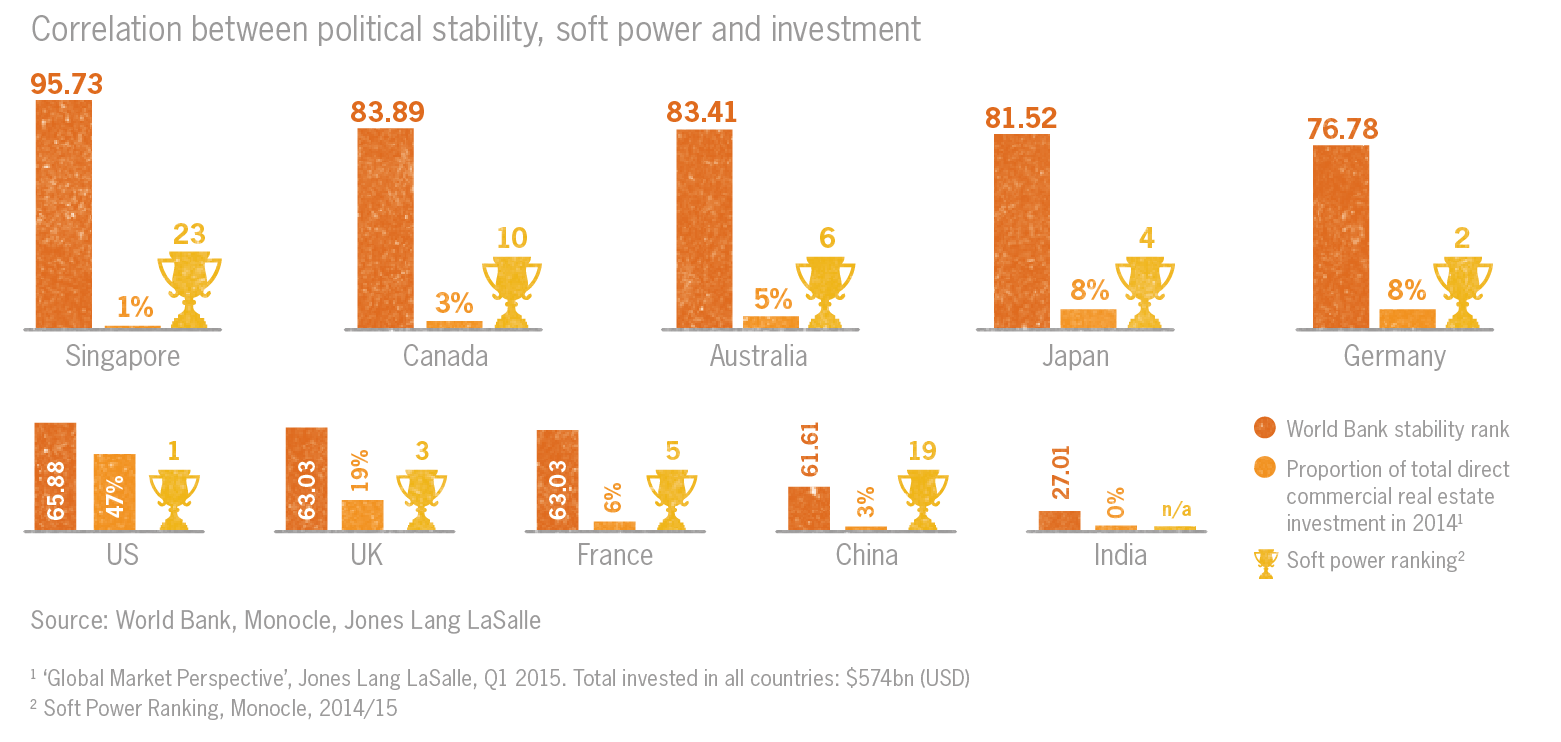
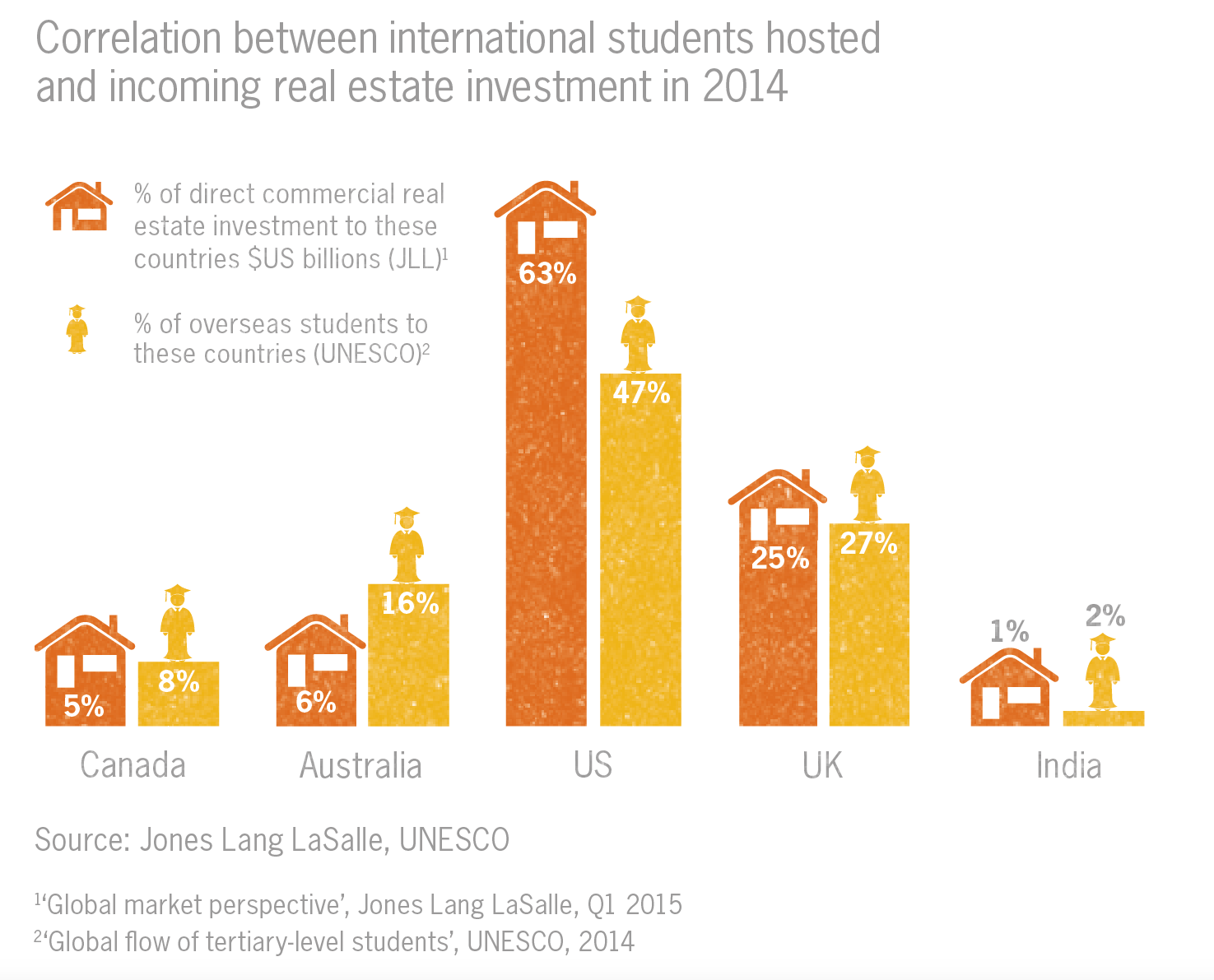
The new report from Grant Thornton finds that the countries with the highest soft power rankings – a measure of a nation’s cultural attractiveness and allure – are not necessarily those ranked highest when it comes to political stability. When exploring the factors proving particularly attractive, a striking correlation emerges between the level of overseas students countries receive, and the amount of overseas real estate investment. (See graphic below.)
Sian Sinclair added:

“In conversations with investors around the world it became apparent that soft power carries serious weight. Further analysis found that investors don’t tend to pick a market without having a connection. And education is one of the most powerful connections; where students go, the real estate money follows.

“But falling into the trap of thinking you don’t need a lot of evidence before making a decision could mean missing out. Investment horizons can be broadened by complementing instincts with use of evidence and analysis. Critical to this is incorporating local expertise, which can often present opportunities which may not otherwise have been considered.

“By balancing gut instinct with greater factual analysis, investors will be best placed to navigate the shifting sands and make the most of previously uncited opportunities.”

Grant Thornton’s new report, Uncovering opportunities for overseas investment and growth, explores the trends, challenges and opportunities facing the global real estate market today. It provides practical, achievable actions for investors looking to harness the forces shaping global real estate activity. To download a copy please www.grantthornton.global

Share this page
  • Facebook
  • Twitter
  • LinkedIn
  • E-mail

CONNECTEZ-VOUS CONNECTEZ-VOUS

  • Rencontrez nos experts
  • Contactez-nous
  • Nos bureaux

À PROPOS À PROPOS

  • Grant Thornton Société d’Avocats
  • People & Culture
  • Presse

LÉGAL LÉGAL

  • Disclaimer
  • Mentions légales
  • Conditions générales de services
  • Charte de protection des Données Personnelles
  • Plan du site
  • Préférences en matière de cookies

Follow usFollow us

© 2025 Grant Thornton Société d'Avocats, Tous droits réservés. Grant Thornton Société d'Avocats est le cabinet d’avocats lié au réseau Grant Thornton en France, dont la société SAS Grant Thornton est le membre français du réseau Grant Thornton International Ltd (GTIL). “Grant Thornton” est la marque sous laquelle les cabinets membres de Grant Thornton délivrent des services d’Audit, de Fiscalité et de Conseil à leurs clients et / ou, désigne, en fonction du contexte, un ou plusieurs cabinets membres. GTIL et les cabinets membres ne constituent pas un partenariat mondial. GTIL et chacun des cabinets membres sont des entités juridiques indépendantes. Les services professionnels sont délivrés par les cabinets membres, affiliés ou liés. GTIL ne délivre aucun service aux clients. GTIL et ses cabinets membres ne sont pas des agents. Aucune obligation ne les lie entre eux.