
• Skip to content
  • Skip to navigation
  • English
  • français
  • English
  • français
Global site
Grant Thornton Société d'Avocats
  • Insights
    • Fiscalité Générale des entreprises
      • Fiscalité Générale des entreprises
      • Pilotage de la politique fiscale
      • Gestion de la croissance
      • Contrôle et contentieux fiscal
    • Fiscalité transactionnelle
    • Prix de Transfert
      • Prix de Transfert
      • Structuration stratégique et sécurisée des prix de transfert
      • Activités à l’international et Business restructuring
      • Contrôles fiscaux en matière de prix de transfert
      • Obligations déclaratives accrues et généralisées
    • TVA
      • TVA
      • TVA domestique et internationale applicable à vos flux
      • TVA bancaire et financière, TVA dans le secteur assurance
      • TVA immobilière et droits d’enregistrement (DE)
      • TVA dans le secteur public et associatif
      • TVA, contentieux fiscal et relations avec l’Administration
      • Règles applicables en matière de facturation
      • Problématiques douanières liées à vos flux internationaux
      • Obligations déclaratives et d’immatriculation à la TVA
      • Taxe sur les salaires
      • Autres taxes indirectes
    • Fiscalité Patrimoniale
      • Fiscalité Patrimoniale
      • Le Diag Transmission
    • Droit économique
      • Droit économique
      • Stratégie de distribution
      • Digitalisation des activités de distribution
      • Relations entre fournisseurs et distributeurs
      • Politique contractuelle des entreprises
      • Contrôle et contentieux en matière de délais de paiement
      • Relations commerciales avec les consommateurs
      • Droit des données personnelles - RGPD
      • Baux commerciaux
    • Droit social et Ingénierie RH
      • Droit social et Ingénierie RH
      • Prestations traditionnelles
      • Santé au travail et qualité de vie au travail
      • Audit du Management des Ressources Humaines
      • Ingénierie RH & People Change
      • Gestion de la conformité RH et des enquêtes internes
    • Droit des sociétés
      • Droit des sociétés
      • Conseil dans la structuration juridique
      • Gestion courante des entreprises
      • Réorganisation d’entreprises
      • Cession et acquisition d’entreprises
      • Evolution de l’actionnariat – Emission de valeurs mobilières
      • Gouvernance et maîtrise des risques juridiques
    • Mobilité Internationale
      • Mobilité Internationale
      • Développement d’une politique de mobilité internationale
      • Mobilité - Obligations déclaratives des salariés
      • Conseil en matière de sécurité sociale
      • Assistance en matière de droit du travail
    • Propriété intellectuelle et technologies de l’information
      • Propriété intellectuelle et technologies de l’information
      • La gestion et l’exploitation de vos portefeuilles de droits
      • La sécurisation de vos projets : conseil et rédaction contractuelle
      • La défense de vos droits : précontentieux et contentieux
  • Nos experts
  • People & Culture
    • L’expérience de la confiance
    • Pourquoi nous choisir
    • Nous rejoindre
    • Un parcours de formation sur-mesure
  • Nos engagements RSE
  • Nos bureaux
  • Actualités
Global site
  1. ACCUEIL
  2. Press releases
  3. 2015
  4. China ranks 14th in Grant Thornton Global Dynamism Index 2015

China ranks 14th in Grant Thornton Global Dynamism Index 2015

23 sept. 2015

China ranks 14th in Grant Thornton Global Dynamism Index 2015

According to the latest survey result of Grant Thornton Global Dynamism Index (GDI) 2015, China ranks 14 among 60 leading economies, above many other developed markets such as France (23=) and the UK (27).
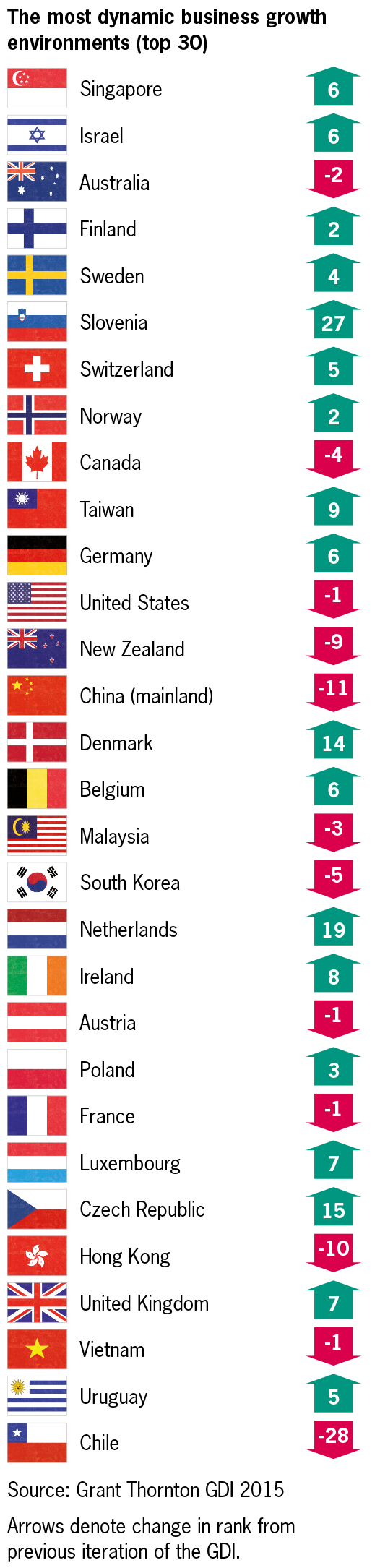
The Grant Thornton Global Dynamism Index (GDI) assesses the business growth environments of 60 leading economies in the world, and judges the development potential of each economy through the changes of related index. The assessment is based on five categories which are likely to lead to a faster future rate of growth, including science & technology, labour & human capital, economics & growth, business operating environment and financing environment.

Economic growth and labour index lead the world

Improved private consumption helped lift the country to top of the GDI in the area of market growth, though the recovery of the global market is still slow. Meanwhile, improving labour productivity and low unemployment helped the economy rank 2 for labour market. Technological infrastructure (16) is another area in which China outperforms other countries due to high IT spending and investment in research and development.

However, there is room for improvement in the dynamism of the business operating (48) and financing (44=) environments. Business operating environments include foreign trade foreign exchange regulations, private enterprise policy, political stability and other risks of laws and regulations; financing environments include financial supervision system, merger   and acquisition growth, enterprise direct investment growth, enterprise tax burden, etc.

Xu Hua, CEO of Grant Thornton China, said: “the speedy development of science and technology in the past 10 years, such as 3D technology and the forthcoming pilotless automobile, presents challenge to traditional labour. However, the role of skilled labour in the global economic development remains essential. Most industries still need a lot of labour to make profits. China's stable labour market ensures a healthy economic development. But we should keep on optimizing our business operation and financing environment to create better development environment for enterprises. ”

Singapore ranks top

Globally, Singapore (rank 1) leads the GDI 2015. It ranks top for financing environment and no lower than 25 in any other growth area, highlighting the country’s robust, broad-based offer to dynamic businesses. Israel (rank 2) has also risen six places this year. It comes top for technology due to strong research and development spending. Australia (rank 3=) drops two places but still ranks in the top five for business operating environment and labour market. Finland (rank 3=) and Sweden (rank 5) have both risen slightly, due to their favourable business operating environments and an advanced technology infrastructure.

Xu Hua, CEO of Grant Thornton China, said: “Market entry decisions are some of the toughest a business leader ever has to face. There are so many factors - both known and unknown - to consider. Uncertainty about what lies ahead can make it hard to make the case for action to colleagues and funding partners, and to manage risk effectively. The GDI can be used as a tool to help identify countries of interest by drawing on 22 indicators in five aspects. Entrepreneurs can use GDI for reference when looking for overseas expansion.”

Share this page
  • Facebook
  • Twitter
  • LinkedIn
  • E-mail

CONNECTEZ-VOUS CONNECTEZ-VOUS

  • Rencontrez nos experts
  • Contactez-nous
  • Nos bureaux

À PROPOS À PROPOS

  • Grant Thornton Société d’Avocats
  • People & Culture
  • Presse

LÉGAL LÉGAL

  • Disclaimer
  • Mentions légales
  • Conditions générales de services
  • Charte de protection des Données Personnelles
  • Plan du site
  • Préférences en matière de cookies

Follow usFollow us

© 2025 Grant Thornton Société d'Avocats, Tous droits réservés. Grant Thornton Société d'Avocats est le cabinet d’avocats lié au réseau Grant Thornton en France, dont la société SAS Grant Thornton est le membre français du réseau Grant Thornton International Ltd (GTIL). “Grant Thornton” est la marque sous laquelle les cabinets membres de Grant Thornton délivrent des services d’Audit, de Fiscalité et de Conseil à leurs clients et / ou, désigne, en fonction du contexte, un ou plusieurs cabinets membres. GTIL et les cabinets membres ne constituent pas un partenariat mondial. GTIL et chacun des cabinets membres sont des entités juridiques indépendantes. Les services professionnels sont délivrés par les cabinets membres, affiliés ou liés. GTIL ne délivre aucun service aux clients. GTIL et ses cabinets membres ne sont pas des agents. Aucune obligation ne les lie entre eux.